Guide
November 16, 2026
Who needs to be involved in a health content audit?
Who should be on your health content audit team? Learn how you can ensure that everyone in your team has a role to play in producing health content that gives people reasons to interact with your products and services.
If you're running a content audit in a digital health team, you'll need to assign roles to keep your team on track throughout the process. No matter how big or small your team is, allocating roles helps to keep everyone accountable and ensures that your pages are consistent across your website.
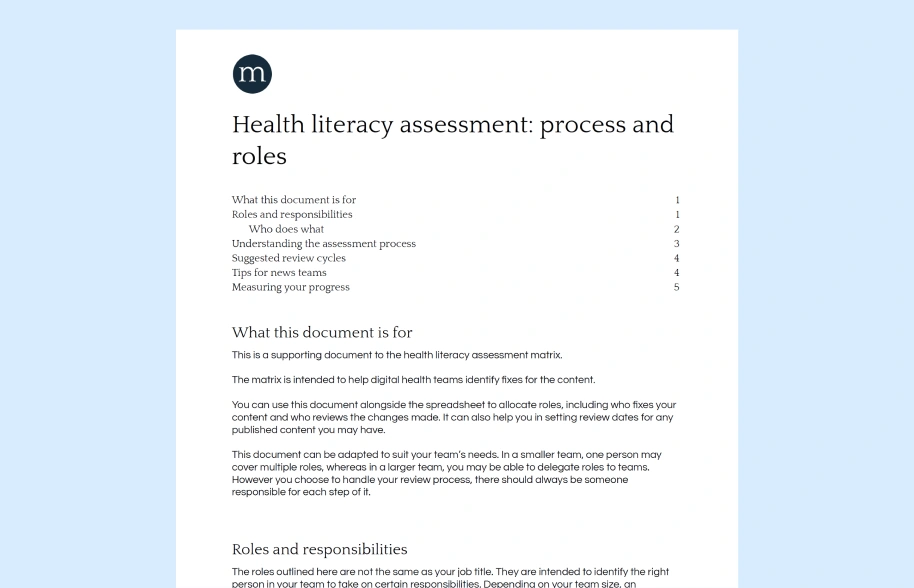
In a smaller team, one person may cover multiple roles, whereas in a larger team, you may be able to delegate roles to teams. However you choose to handle your review process, there should always be someone responsible for each step of it.
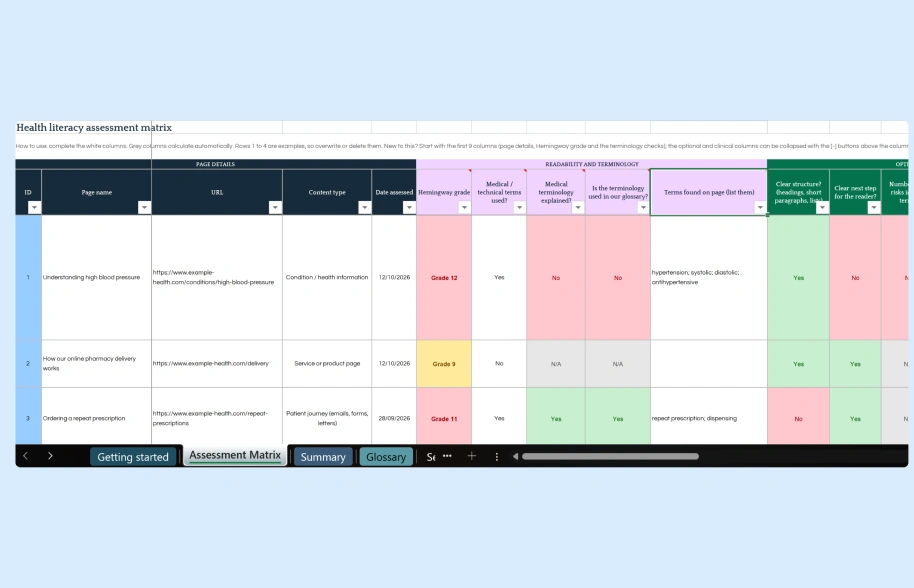
You can use the advice outlined on this page alongside this health literacy assessment spreadsheet. With it you can assign roles, including who fixes your content and who reviews the changes made. It can also help you in setting review dates for any published content you may have.
Roles and responsibilities
The roles outlined here are not the same as your job title. They are intended to identify the right person in your team to take on certain responsibilities. Depending on your team size, an individual may take on several roles.
Which roles are needed during your health content audit?
This RACI matrix can help you figure out which people in your team will be:
- R = responsible (does the work),
- A = accountable (final say),
- C = consulted
- I = kept informed
What steps need to be included in the assessment process?
- Getting started. Agree on the target reading grade, who signs off what, and how often content is reviewed.
- Inventory. List the pages in scope of your assessment in the matrix, with their name, URL and content type.
- Assess for readability and correct use of terminology. Score each page in Hemingway and use the spreadsheet to confirm completed readability and terminology checks.
- Prioritise your fixes. Use the Priority column (High, Medium, None) to decide what to fix first.
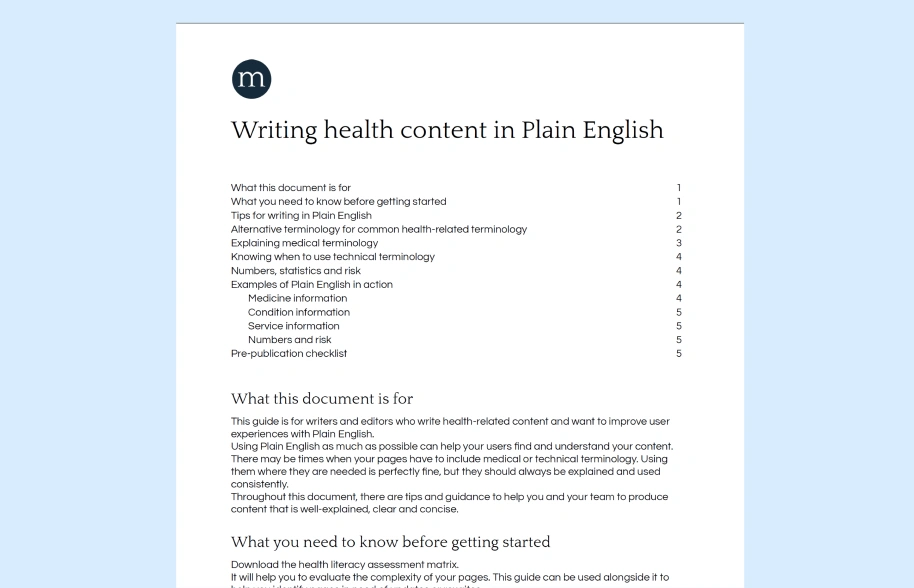
- Revise or rewrite your pages. Work through the recommended changes, using the Plain English quick guide.
- Clinical and compliance checks. Get sign-off before anything is published.
- Test your content with a lay audience. Ask people from your audience to try the revised content.
- Publish and re-score. Run Hemingway again, record the new grade, and update the status.
- Review on a schedule. Set a next review date so the page does not go out of date.
Hemingway Editor is only a suggested tool. You can use any platform or tool of your choice to assess the readability of your content.
Suggested review cycles
Tips for new teams
If your team has never run this type of content review, it’s okay to start small.
- Evaluate your most important pages. You don’t have to start by reviewing every single page on your website. Choosing pages that are implicated in onboarding journeys or house information about your main products and services is enough to begin with.
- Fix your worst pages first. If you have pages that use medical terminology inconsistently, include misleading statistics or figures or haven’t been reviewed by a clinical professional in a while, you should prioritise them to protect patient safety, build trust in your brand and maintain your credibility.
- Agree on your process and then bring in your reviewers. You should know what your review process will look like before you begin. Once you’ve identified pages that need refreshing, and you’ve developed processes your team can agree on and stick to, then you can involve clinical, compliance and lay reviewers.
Measuring your progress
Proving the value of your changes relies on regular reporting. Four measures worth tracking using the health literacy assessment matrix include:
- the share of assessed pages that score green
- the average Hemingway grade and how much it falls on pages you have rewritten
- the percentage of high- and medium-priority pages where changes have been made
- the number of pages with an overdue review.
These measure your content. They show you and your stakeholders when writing has become simpler. What they can’t do is tell you whether people understand it more. Working with your test readers will help build that understanding.
Download the roles and responsibilities sheet
Every team has its own shape and priorities. If you want to run an audit but use a different structure, you can use the downloadable version of the advice on this page and edited it suit your team's needs.
Download roles sheets