Opinion
November 16, 2026
How to run a content audit with health literacy in mind
Health literacy is about empowering your audience to find, understand and use health-related services and advice. Learn how to audit your health content for its readability, terminology and clear next steps.

Working on your next content strategy for your digital health product? For it to be successful, health literacy has to be a part of your approach to its development.
That’s because it allows people to find, understand and use your content and, therefore, your products and services properly.
This guide shows you how to audit your content for health literacy. You'll learn what to check for, who should be involved, which readability targets to use and how to track progress.
What is health literacy?
Health literacy is producing content that is inclusive to all. It allows people to access and decipher the health information in your content. This, in turn, can lead to better health outcomes and decision-making.
In the UK 1 in 7 people have literacy skills at or below Entry Level 3. This is the level that a child aged between 9 and 11 can read and understand content. 1
This issue is exacerbated when it comes to health information. Roughly 4 in 10 adults struggle to understand and use health information. This worsens when numbers are involved. According to Public Health England, more than 6 in 10 adults find it difficult to understand health content that relies on their numeracy skills.2
A team with a good digital health product or service respects that people of differing backgrounds can benefit from content that considers health literacy. So if you want people to engage with yours, creating content that is clear, findable and actionable has to be at the forefront of your strategic thinking.
It can be the difference between people knowing why your product or service should matter to them and not.
Why does health literacy matter?
Health literacy is deeply connected to finance, social resources and lifestyle. People with poorer financial or social resources typically have poorer health literacy. This means that they may engage with health-related content on a different level to those with higher levels of health literacy.2
In turn, people with poor health literacy have worse health outcomes. In terms of lifestyle, they may have higher rates of obesity, poorer diets and an increased likelihood of smoking than people with better health literacy. 2
And when people can’t understand or engage with health content, their ability to take control and make empowered decisions about their health is reduced.
If you’ve identified a health-related problem and your digital products work to address it, then you must develop content that works for an audience that will include people with varying health literacy levels. By giving people across that spectrum the opportunity to engage with your content, you may contribute to better health outcomes for everyone.
How does health literacy affect your business?
Health literacy allows people to make informed decisions about their health. When they can find your content, understand it and take positive steps towards managing their wellbeing based on it, their health outcomes improve.
From a business perspective, engagement with your brand can increase, as can customer retention and revenue.
For example, a brand with a weight management service that explains how its medications work and promotes healthy lifestyle changes through recipe, exercise and clinical support content may have customers with higher lifetime value than those who don’t. The additional support creates pathways to other products and services they may offer and shows people that their needs as individuals are respected.
If your content is unreasonably complex, patients who could stand to benefit from what your company has to offer miss out. And from a business perspective, potential leads are, therefore, lost.
With that in mind, the content you develop, whether it’s UX microcopy or long-form blog posts, has to explain and contribute to patients’ digital journeys without causing confusion and alienation.
But how do you get to the point where your content is supporting the health literacy of your audience?
Content challenges for digital health teams
In my experience, customer journeys in the digital health space are often complicated. The clinical and regulatory requirements involved mean that the content your brand produces can have a level of complexity that doesn’t exist outside of this realm.
Companies in the digital health space have a duty of care that may include:
- Explaining how medications, devices or diagnostic test kits work, including statistical data on their efficacy
- Providing transparent pricing information
- Detailing who medications, devices and diagnostic tests are appropriate for
- Providing clear information on side effects
- Signposting to support where necessary
- Explaining how counterfeit or black market products can be avoided
- Creating consultations that allow patients to provide healthcare professionals with relevant information
- Outlining the process steps for contact with a prescribing healthcare professional as well as approval for any services that involve prescriptions
But that doesn’t mean that your public-facing content shouldn’t be clear or easy to follow. Taking the time to assess your current content, analyse your key metrics and think about the people who will actually use them rather than your internal stakeholders can build a foundational understanding of how well your content is working.
How to do a health content audit
A content audit is an assessment of the content in your digital estate. It allows you to review it against a certain set of criteria that you define.
If you want to make your content better aligned to your audience’s health literacy needs, a content audit can help you understand what’s working, what needs to be fixed and what you might need to remove.
It’s not a one-off activity. Your team should have a regular review cycle for checking how well your content works and how your users respond to it.
If you’re conducting an audit for the first time, it doesn’t have to be overwhelming. You can start small and build your process over time to include more pages and to align with any process documents you produce from your learnings.
Planning your content audit
Decide which pages to include
A content audit doesn’t need to include every page on your website. This is especially true if you have a lot of content and are just getting started. Select a few key pages. These might be pages that are central to checkout or your key informational journeys.
You’ll need to document the names, URLs and content types of any pages you decide to include.
You’ll have a record of the pages that were assessed that can be shared with your team.
Assign roles and responsibilities
Content teams come in all shapes and sizes. You might be the only person responsible for planning and delivering content within your organisation, or you might be part of a large or growing team.
Assigning roles and responsibilities means that everyone within your content team structure is held accountable and can share their perspectives on the effectiveness of your content in terms of health literacy.
Some people within your team might hold multiple roles. For example, your content lead (the person responsible for setting review cycles and prioritising pages for review) might also be your glossary owner (the person who updates your glossary that houses your medical and technical terminology and its plain English definitions).
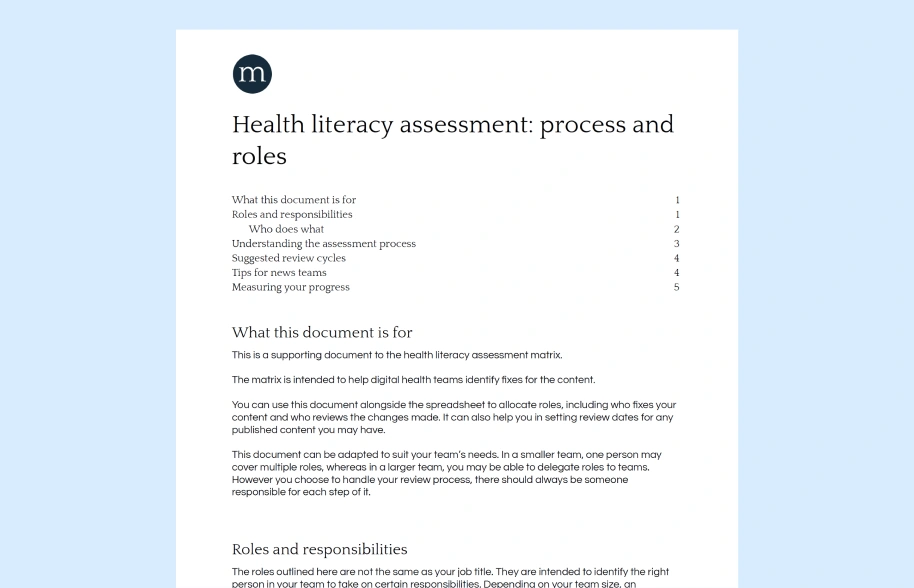
If you need help figuring out which roles might be needed in your team structure, check out my roles and process guide.
Use your assessment tools
Health content that is easy to understand will be simple, clear and written to respect the reading age of the majority of your users. There are a variety of tools you can use to check how well your content reads.
Hemingway Editor is a free tool that allows you to check reading age, sentence length, passive voice and the complexity of your content. It reports using US school grades so you’ll need to add a year if you’re based in the UK.
If your content is jargon-heavy, it will increase your reading age. In some cases, this will be unavoidable. You and your team will have to decide on the terms and pages that will be slightly more complex while ensuring that appropriate explanations and definitions are provided.
Document and track your findings
As you work through your selected pages, you’ll need to record the problems you spot. You should also track the changes you make so your team knows how your content has been modified and can determine whether it’s caused changes to your users’ behaviour.
If you don’t have any content-related governance documentation in place yet, you have the perfect starting point for creating content that supports health literacy and patient confidence.
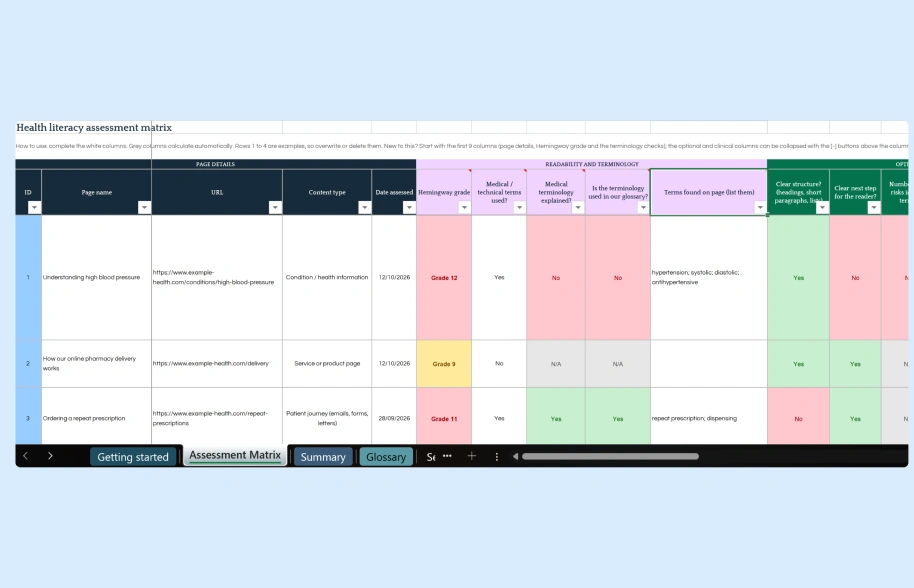
Use my health literacy assessment matrix if you need help getting started.
Download my health literacy assessment pack
Whether you’re part of a new content team or a solo health content professional, you can use my health literacy assessment pack to help steer your next audit.
- Health literacy assessment: process and roles
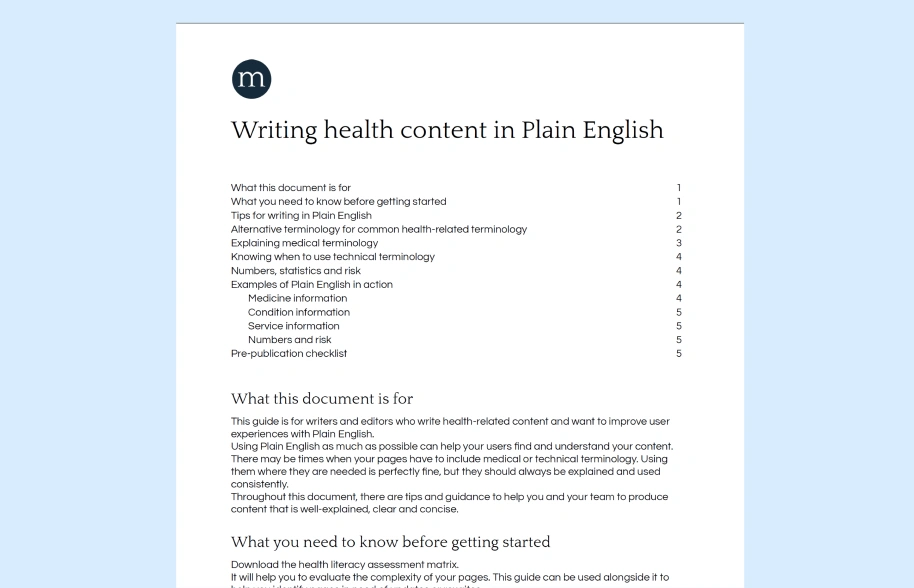
- Writing health content in Plain English
- Health literacy assessment matrix
Download health literacy packFinal thoughts
Digital health companies have to keep their audience in mind. People of all backgrounds experience health challenges. And that means that no one should be excluded from accessing content that can improve their quality of life or wellbeing.
Health literacy has to be a major consideration in your content production process. Making it a priority means that people know how to use your content and what to expect from your products and services.
References
- National Literacy Trust (2024). What do adult literacy levels mean? [online] National Literacy Trust. Available at: https://literacytrust.org.uk/parents-and-families/adult-literacy/what-do-adult-literacy-levels-mean/ [Accessed 8 Nov. 2026].
- Public Health England (2015). Local action on health inequalities. [online] GOV.UK. Available at: https://assets.publishing.service.gov.uk/media/5a80b62d40f0b62302695133/4b_Health_Literacy-Briefing.pdf [Accessed 8 Nov. 2026].