Guide
November 16, 2026
How to write health content in plain English
Developing health content people can understand and act on can help change health outcomes for the better. See how you can bridge the gap between health content complexities and audience engagement with tips on plain English writing.
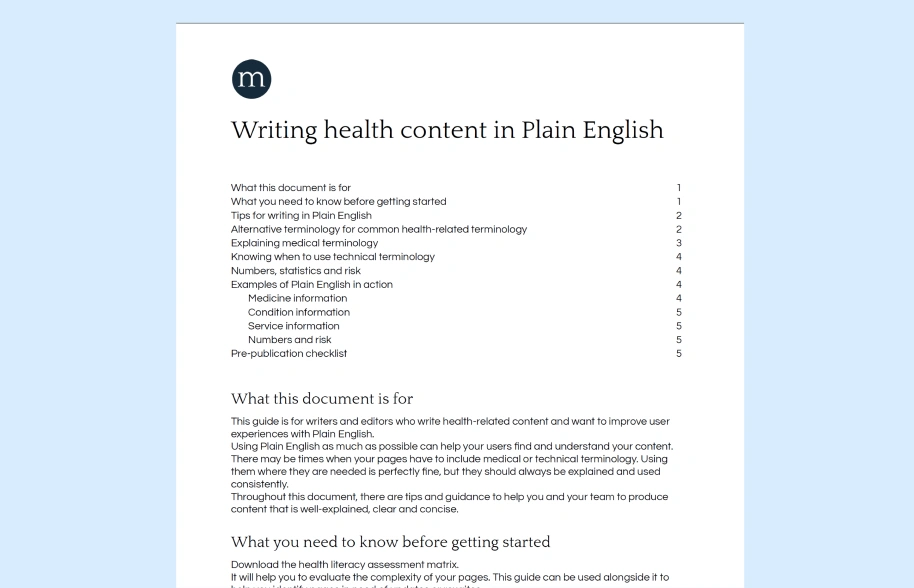
This guide is for writers and editors who write health-related content and want to improve user experiences with Plain English.
Using Plain English as much as possible can help your users find and understand your content. There may be times when your pages have to include medical or technical terminology. Using them where they are needed is perfectly fine, but they should always be explained and used consistently.
Throughout this document, there are tips and guidance to help you and your team to produce content that is well-explained, clear and concise.
What you need to know before you start writing
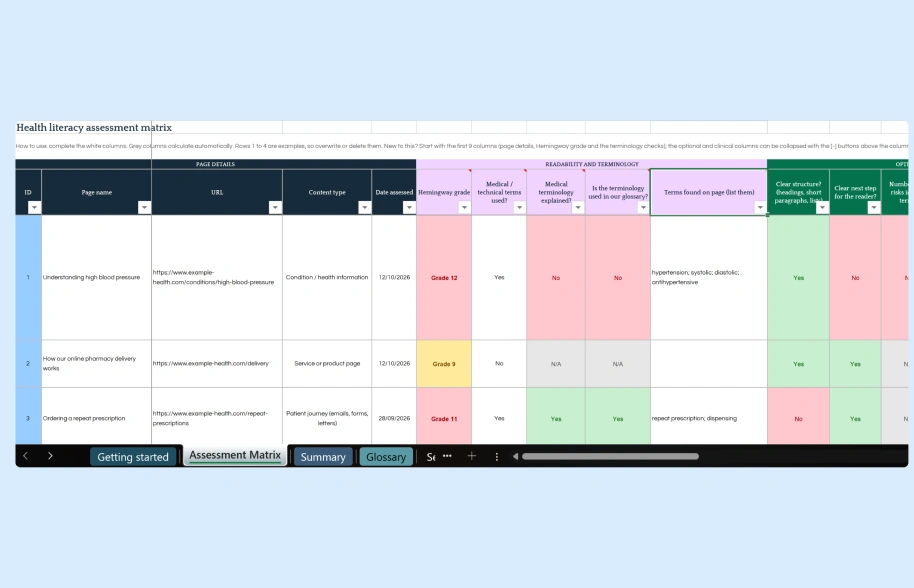
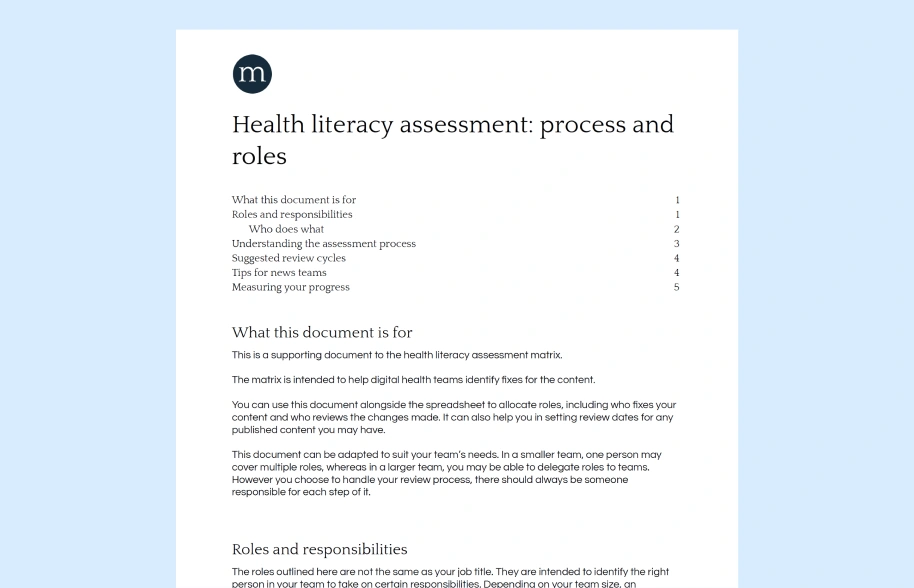
Download the health literacy assessment matrix.
It will help you to evaluate the complexity of your pages. This guide can be used alongside it to help you identify pages in need of updates or rewrites.
For any page that you are evaluating, use Hemingway Editor or a readability tool of your choice to assess its readability. A Hemingway score of grade 4 or below typically aligns with the average reading age in the USA. For the UK, adding 1 to the grade will give you the correct school year (Grade 4 is roughly the same as Year 5, where children are aged between 9 and 10).
The use of medical and technical terminology will increase the Hemingway score of your assessed page. This will happen even when the rest of your copy has been written in Plain English. This doesn’t mean that your page isn’t readable. A higher score in this scenario is acceptable.
Tips for writing in Plain English
Writing in Plain English relies on a few simple concepts. Wherever possible, you should:
- Talk to your audience, not at them. Rather than writing in the third person, address your readers directly. Using the pronouns “you” and “we” can help your users understand what you’re talking about in context.
- Lead with instructions or relevant information. You should lead with your key message. Front-loading sentences and structuring titles to help your users extract the main pieces of information helps build understanding and prevent drop-off in journeys.
- Maintain short sentences and paragraphs. Your sentences should be 15 and 25 words long so that your content isn’t visually dense and users don’t get lost.
- Use common words. Using everyday words makes your content accessible to people of different backgrounds. For example, more people will understand the word “start” over “commense”.
- Make next steps clear. Tell your users what to do, who to contact, and when to get urgent help.
- Explain medical terms the first time they appear. When you need to use a medical term, you need to tell users what it means. For example, hypertension is high blood pressure. Remember to spell out any abbreviations too.
- Make numbers and statistics meaningful. Don’t write numbers in words (100 instead of one hundred) and avoid percentages, which can be difficult to visualise (1 in4 instead of 25%).
- Check your work. Review your own work for structure, grammar and spelling. If you have a peer-review process, your colleagues should also sense- and fact-check your copy.
Alternative terminology for common health-related terminology
Explaining medical terminology
Whenever you use a medical term in your copy, it has to be explained. This helps users understand the topic addressed in your content.
But you must use the same definition or explanation whenever the term is used.
Creating a glossary of common medical terms used by your team can help in producing consistent content. Your writers and editors can refer to it for approved terms and wording.
To explain medical terms, you could choose to:
- Use the common term first, followed by the medical term. When users are familiar with an everyday phrase, you might opt to use them first. The medical terminology would then be placed in brackets. For example, “heart attack (cardiac arrest)” or “high blood pressure (hypertension) ”.
- Use the medical terminology first and put the explanation in brackets. If you know your users will be reading a letter, test results or label, using the medical terminology first is preferred. For example, tachycardia (a heart rate that is higher than normal).
- Use tooltips or glossary links. When a medical term has a longer explanation, tooltips and glossary links can help your users access it without overwhelming your page content. You must make sure that your tooltips are compatible with screenreaders.
Knowing when to use technical terminology
There are few scenarios where you must use technical terminology. But you should opt for plain or common phrases if they don’t reduce the accuracy or clarity of your content.
Use technical terminology when:
- Writing for healthcare professionals
- A plain alternative would be less accurate or could mislead
- Users will see it on a label, letter, test result
Numbers, statistics and risk
- On health information pages, numerals should be used to describe any value (1,2,3,4 etc.) This is because they are easier to understand than written words.
- Avoid percentages where possible. So 70% could be expressed as 7 in 10 to help your users better understand scope and impact.
- If you’re comparing figures, use the same denominator. So “2 in 100 compared with 5 in 100” rather than “1 in 50 compared with 1 in 20”.
- Use units when necessary and say what they mean in practice. For example, "500 mg (one tablet)".
- Avoid phrases like "doubles your risk", which mean little without the actual numbers.
- Tell your users what they need to do. If they need to book an appointment or contact emergency services, this should be clear within your content.
Examples of Plain English in action
Medicine information
Before: Patients are advised to discontinue use immediately and consult a healthcare professional if they experience any adverse reactions.
After: Stop taking this medicine and talk to your doctor or pharmacist if you get any side effects.
What changed: shorter sentence, active voice, everyday words, and a clear action.
Condition information
Before: Hypertension is a chronic condition characterised by persistently elevated arterial blood pressure, which increases the risk of cardiovascular events.
After: High blood pressure (hypertension) means the force of blood against your artery walls stays too high. Over time, this can raise your risk of a heart attack or stroke.
What changed: plain words first with the medical term explained, two shorter sentences, and "you" language. Note that "hypertension" is still there because readers will meet it elsewhere.
Service information
Before: Prescriptions will be dispatched within 2 working days subsequent to clinical approval.
After: We will send your medicine within 2 working days of our clinical team approving your order.
What changed: "dispatched" and "subsequent to" were replaced, and the reader is the focus of the sentence.
Numbers and risk
Before: The risk of this side effect is 10%.
After: About 1 in 10 people get this side effect. This means about 9 in 10 do not.
What changed: a natural frequency instead of a percentage, with the other side of the picture stated.
Pre-publication checklist
If you’ve decided to use the health literacy assessment matrix, the checklist below can help you identify areas for improvement in your content.