Strategy

Design thinking for better weight management conversion

I built a content ecosystem to encourage education, trust and conversion to order among a pharmacy’s weight loss medication customers

Content strategy
Commercial strategy
Audience research
Weight management content strategy
Overview

Creating a cohesive content strategy that married business goals with user needs

Well Pharmacy was launching its updated online weight management clinic and needed a content strategy that would help patients understand their options, support confident decision-making and improve conversion rates. 

‍

The pharmacy retailer had previously had an in-store service for the weight loss medication, Saxenda (liraglutide), which it directed potential customers to on its website but planned to expand its reach with the introduction of newer, more effective weight management products. It had spun up a weight loss landing page for its new SKUs, Wegovy, Mounjaro and Orlistat, but aimed to lessen friction in conversion-to-order journeys for improved revenue. 

‍

The team involved needed:

  1. Expanded reach to capture digital customers in a crowded market
  2. Find points of difference in its service proposition versus its competitors
  3. Ensure that weight management product journeys were friction-free
The pharmacy had a library of content but it lacked EEAT signals and wasn't connected as a step in any purchase journeys.
The pharmacy had a weight management customer demographic which skewed female, high-income and who desired wraparound weight loss support.
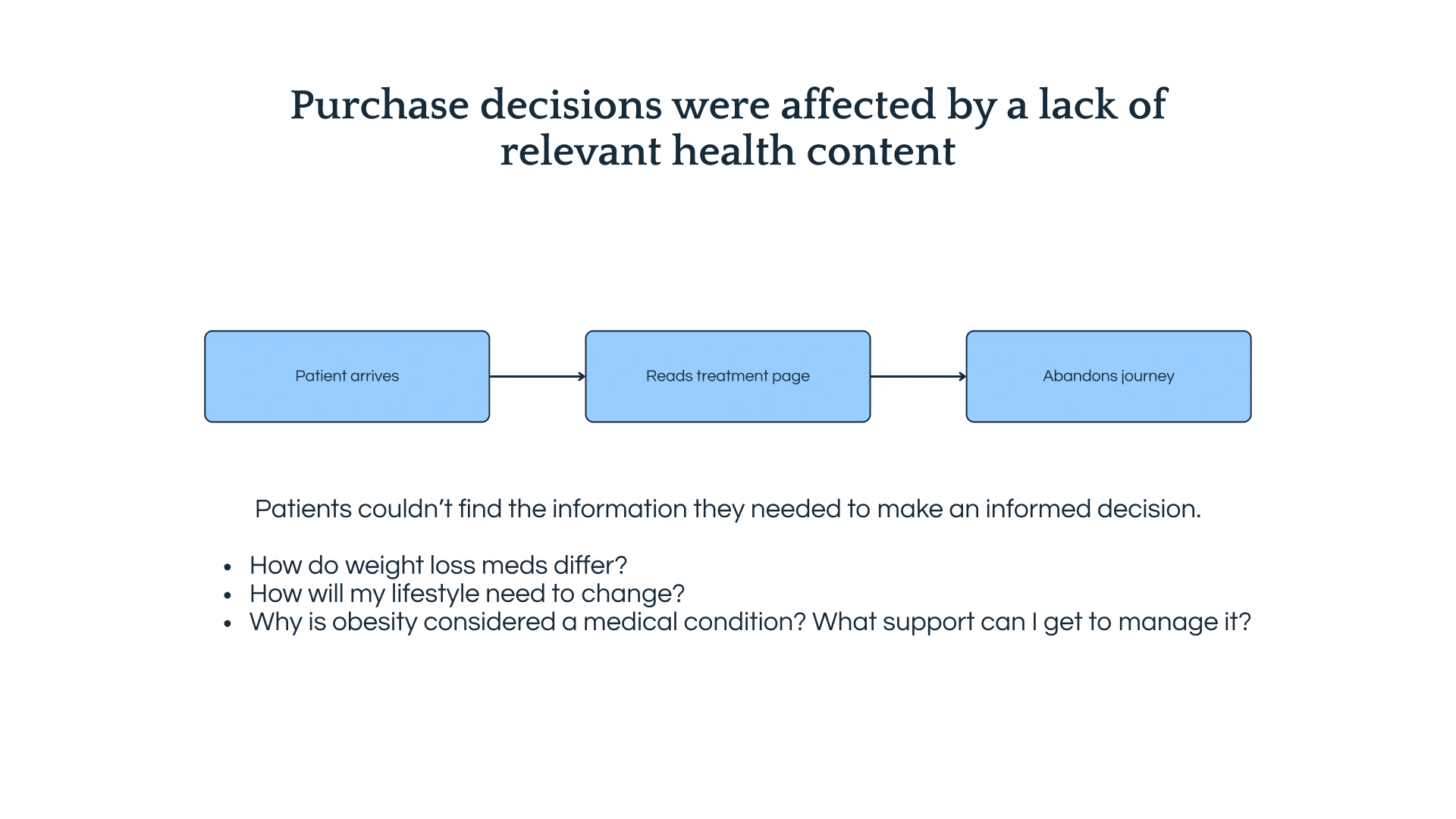
Drop off in purchase journeys was caused by a lack of relevant content on pricing and alternative treatment options.
Key outcomes

3x

Higher repeat session retention for Health Hub users . A signal of higher lifetime value, not just first-visit conversion

£150

Average order value for Health Hub viewers versus £87.30 for non-viewers. Content engagement is improving not just whether patients buy, but how much they spend.

8.35%

Of Health Hub (the website’s health information library) viewers convert to a weight management order versus 3.04% of all users, a cohort converting at nearly 3× the rate.

Indirect path

To weight loss purchase topics like heart health, menopause and mental health are closely linked to weight management. Users on informational journeys through these topics are reaching key touchpoints in their decision-making around medicated weight loss treatments.
Challenge

Uncertainty in purchase decisions stemmed from valuable content and context being hidden or missing

Survey data I gathered and journey map visualisation showed that patients felt uncertain about their purchase decisions. They would hit a weight management landing page and feel uncertain about which option was right for them and how it truly compared, in terms of value and efficacy, to others.

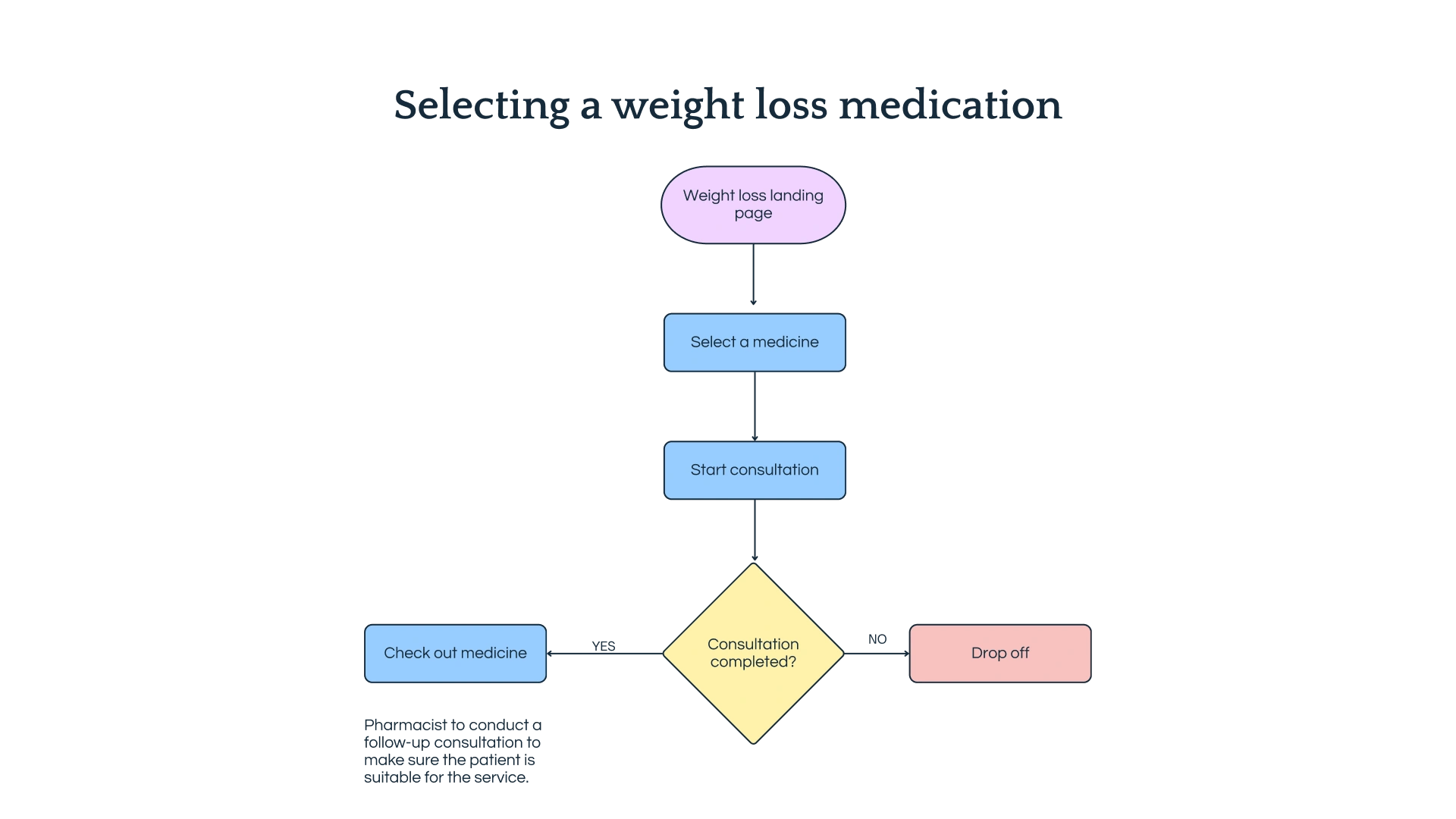
Clinical guidance and General Pharmaceutical Council (GPhC) standards required that all patients have an online consultation that would be reviewed by a pharmacist. They would then (if approved) go on to have monthly check-ins with pharmacists who would check if they were still eligible for the service and medication.

But the journey from product consultation to completed order was a point of friction. Some patients felt like they didn’t have the right level of knowledge to make an informed decision about their medication choice. The lack of professional support before starting treatment was another area of concern.

Patients found it difficult to select a medication to suit their needs.
My thinking

Education-motivated users were more inclined to buy health-related products

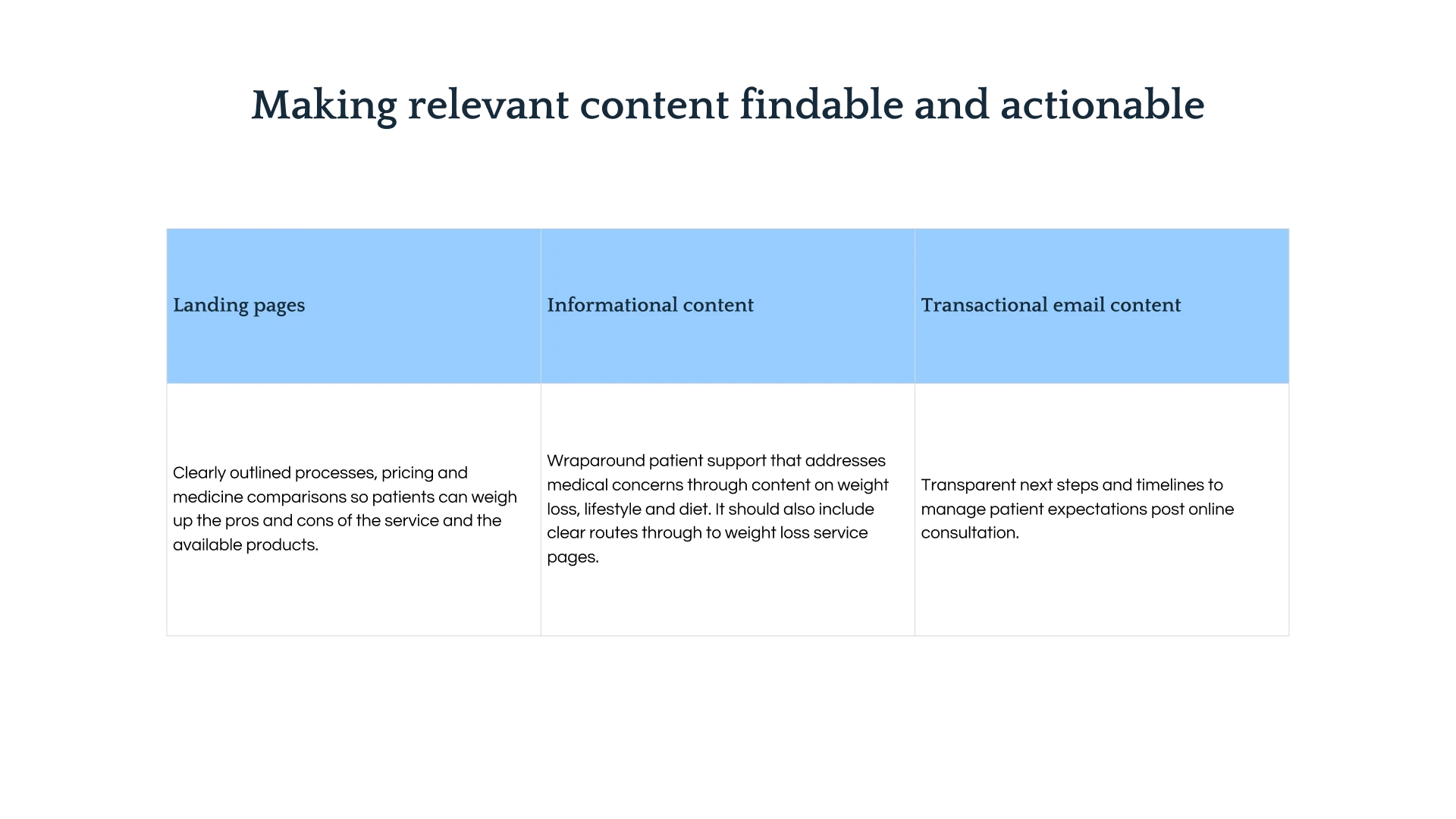
Based on user behaviour and feedback, it was clear that improvements had to be made to make the service proposition attractive to users. They needed to be able to compare medicines with ease, understand when and how they would hear from pharmacists and find self-serve content to build their knowledge on weight management.

‍

Beyond changes to commercial and transactional content, it was essential to build a content marketing strategy to encourage patient conversion. 

‍

Well Pharmacy had an existing health information content library as part of its Health Hub. This included a variety of pages on weight management and obesity-related health conditions. This, when updated to include clear routes into weight loss commercial pages, could be an important asset in conversion to order. Previous pieces of work related to this informational content showed that Health Hub viewers had higher average order values than those who didn’t as well as better lifetime value than those who didn’t. Capitalising on this, by making this content more visible could help support existing customers and build awareness of the weight loss clinic among education-driven leads.

Content needed to made findable and actionable.
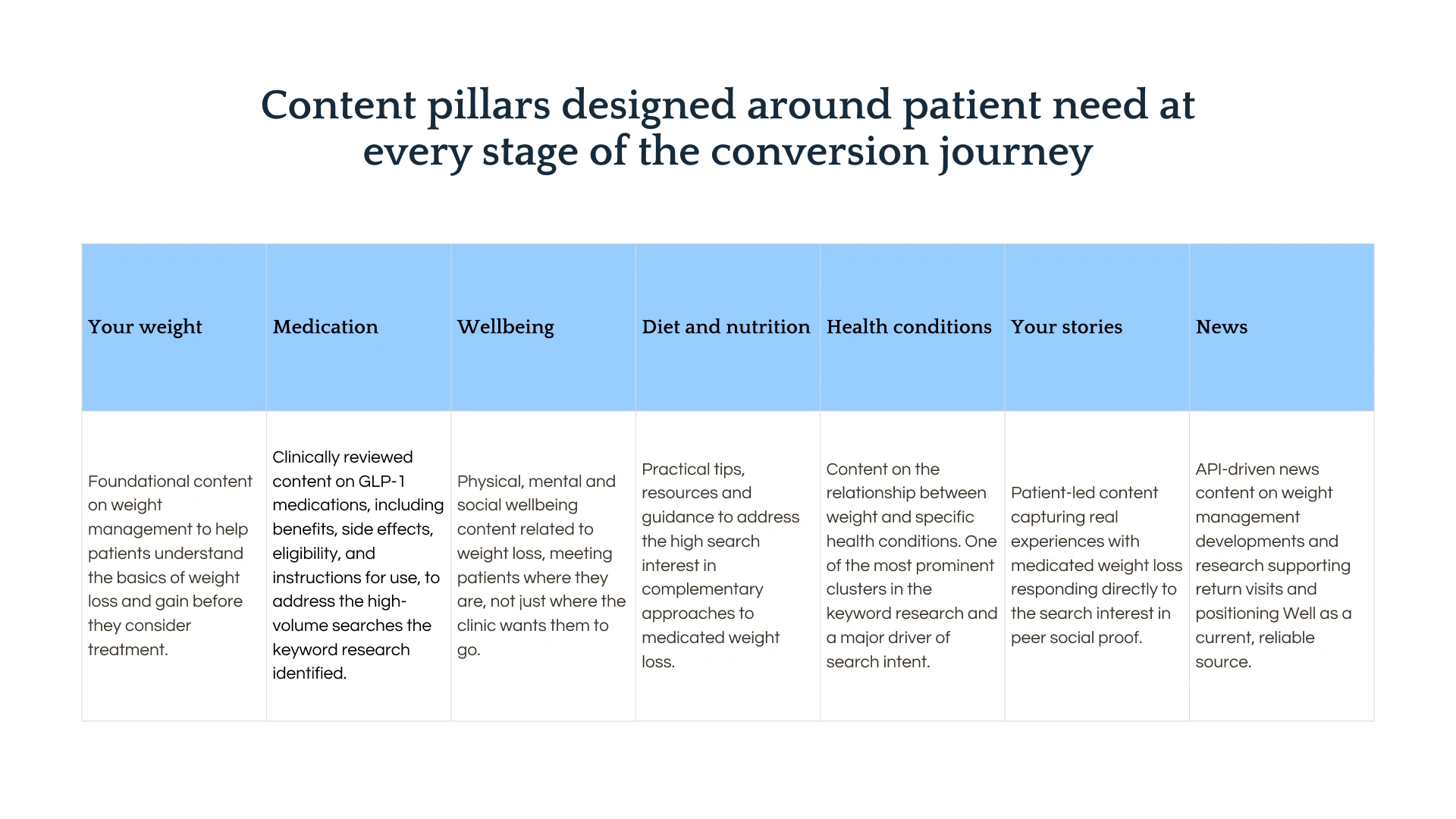
7 content pillars were developed to cover areas of interest for weight management customers.
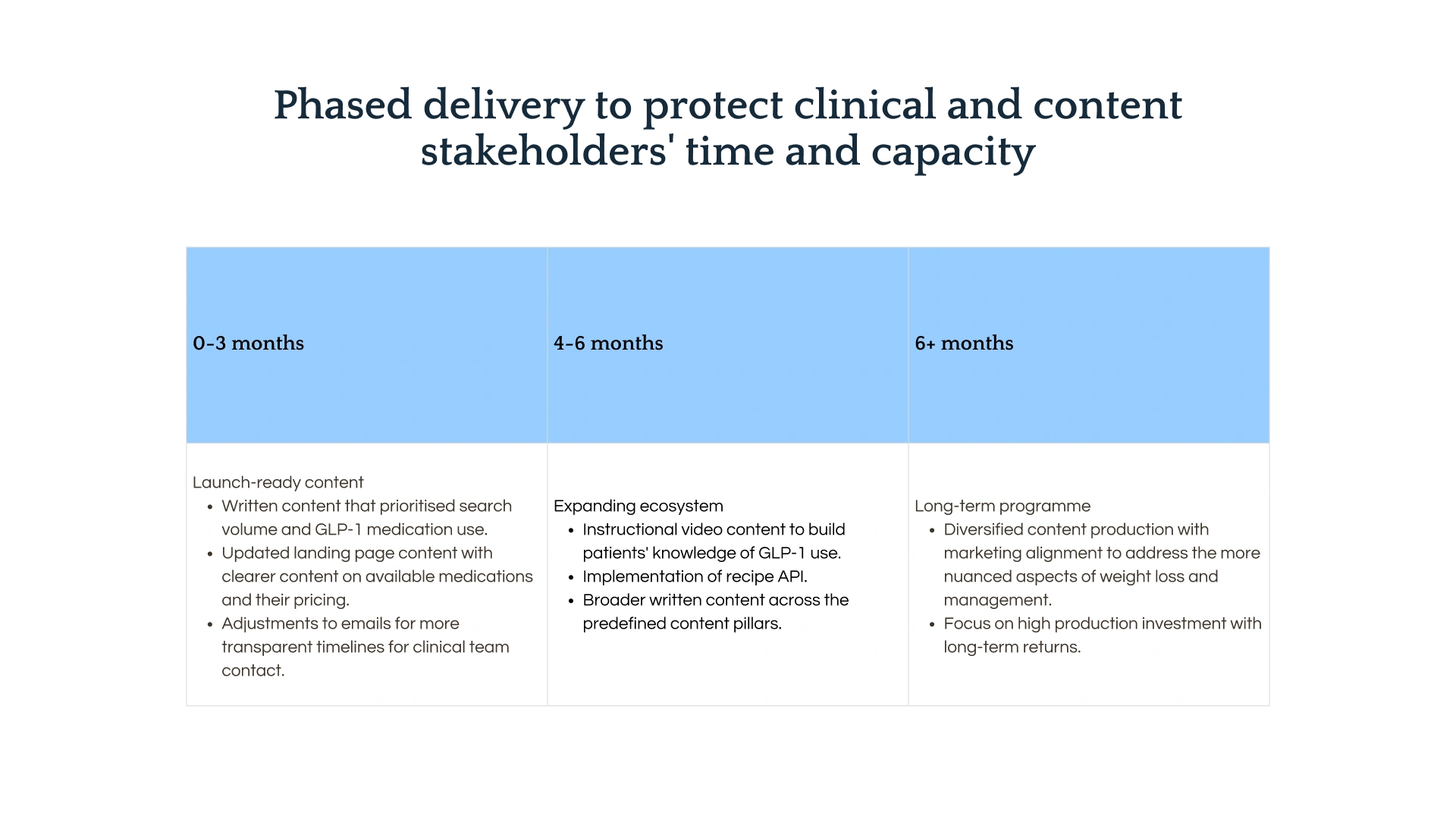
A phased delivery plan.
My approach

Prioritising user needs over conventions build trust and authority

Given that Health Hub visitors were most inclined to make health-related purchases, my strategy aimed to extract the value of existing content, produce content that served the needs of customers as outlined in the survey and feedback I had received and to make commercial landing pages more transparent.

As part of this work, a 7-pillar content strategy was produced that covered areas that were important to users. It was intended to speak to audience needs and provide reassurance for those who would take longer to convert. In producing content this way, I wouldn’t necessarily be meeting the conventions seen among competitors but finding a point of differentiation through content.

Given the nature of the content, it would need to be clinically reviewed. But I knew that the clinical stakeholders would have limited capacity to do this. This led to a phased delivery plan. In the first 3 months, commercial landing pages would be updated along with transactional emails and a batch of informational content.

The second and third phases would include the expansion of the content ecosystem to include a diversified range of content to help build authority and trust.

Learnings and reflections

Content is the glue behind a successful service

By making journeys to and from commercial and informational pages clearer, users showed greater interest in completing medicine purchases.

Architecture should follow audience, not convention

The 7 pillars weren't chosen because they covered obvious weight management topics — they were chosen because the survey and keyword research showed exactly what the audience was looking for and where existing content was failing to meet them. Research-led architecture produces a more coherent ecosystem than starting from a content type list.

Commercial grounding makes strategy defensible

Translating the 1.58% conversion rate into actual margin figures — £26,155 from the Health Hub cohort on Wegovy, £21,557 on Mounjaro, rising to £159,159 and £131,180 respectively across all converting users — made the case for investment in a way that audience data alone couldn't. Every strategic recommendation was more persuasive for being anchored to a number stakeholders already cared about.

Format decisions are strategic, not executional

Treating video, podcast and API content as Phase 2 or 3 additions rather than afterthoughts meant the production plan was coherent from the start. Deciding formats early also forced useful questions about clinical review requirements, production capacity, and where the biggest return on effort would come from.

Plan for GenAI search from the brief, not the audit

The audit identified GenAI's emerging role in health information search as a gap in the existing SEO strategy. Building EEAT signals — clinical authorship, referenced sources, evidence hierarchies — into the written content framework from the outset was both a quality decision and a long-term visibility decision.

More case studies