Audit

Addressing pain points in a prescription management app

After an audit revealed friction in key prescription app journeys, I worked with a product designer to fix challenges faced by users during onboarding and beyond.

Content design
CX audit
UX research
Digital Pharmacy CX audit
Overview

Discovering the reasons for declining prescription orders

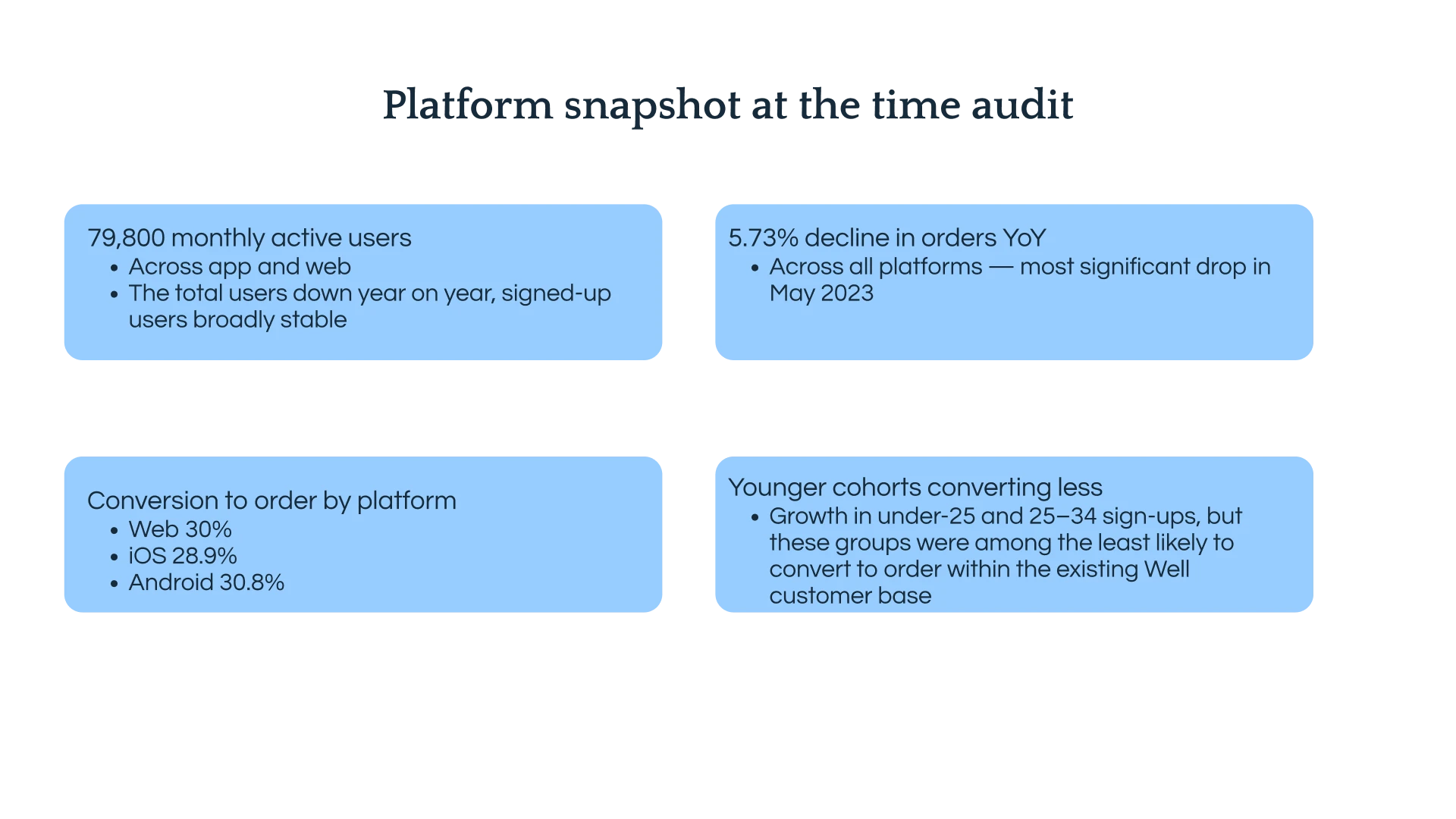
In 2023, I was tasked with investigating the reasons for the decline in nominations (the process of choosing a pharmacy to handle an individual’s prescriptions) for Well Pharmacy’s prescription app. Although the number of sign-ups had remained stable year-on-year, the digital pharmacy team was faced with fewer orders (down by 5.73%). 

‍

A structured audit was conducted to pinpoint the areas of user frustration and improvement. 

‍

I worked closely with a product designer to interrogate flows on both the web and mobile versions of the app, develop content solutions and plan out immediate and future fixes to customer problems.

‍

Although some of these areas for improvement could be actioned quickly through content changes, others required input from other stakeholders and were prioritised according to their roadmap and capacity. 

‍

The changes made resulted in a reduction of sign-up drop off and a stabilisation in nomination to order conversion.

Audit findings.
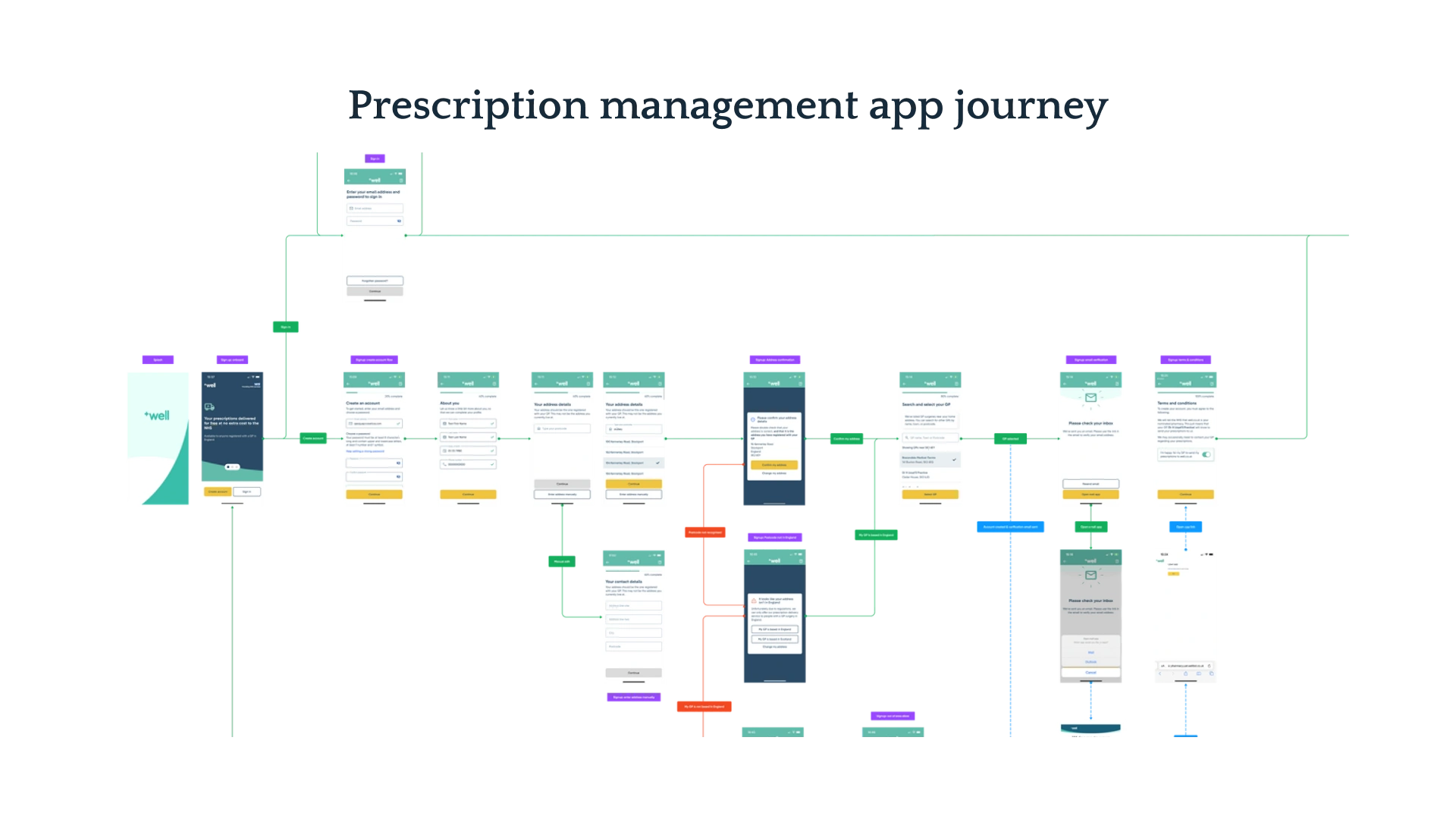
Prescription management onboarding flow.
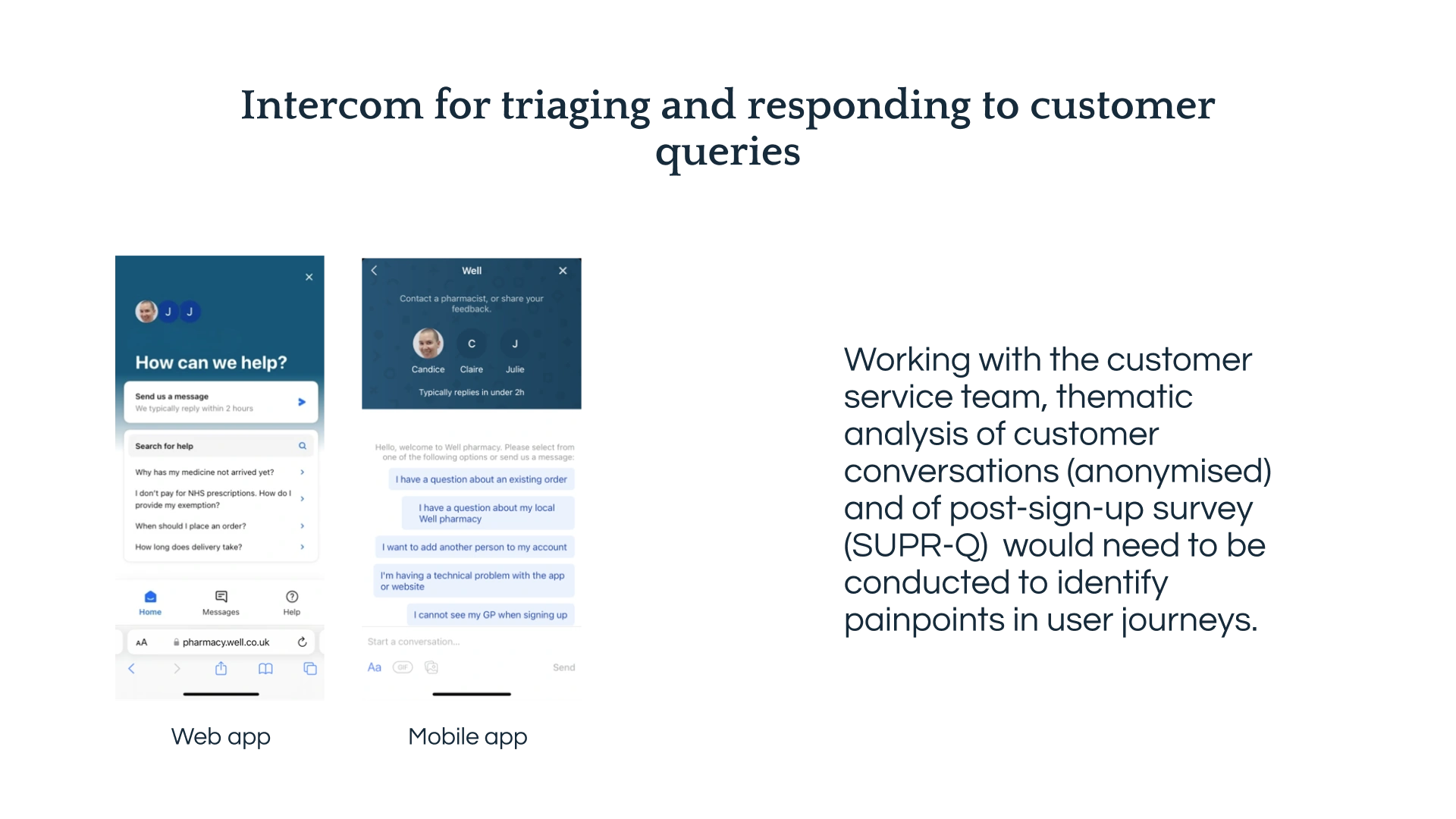
Chatbot and customer service challenges.
Key outcomes

685

Customer survey responses analysed

6

Content and UX failures identified across sign-up and order management

4

Recommendations implemented, including sign-up barriers removed and app store copy updated

Challenge

An app challenge that required cross-functional collaboration

From the onset, it was apparent that several functions would have to be involved in the project. For example, marketing spend had driven sign-ups, particularly among younger cohorts. There was growth in under-25 and 25–34 sign-ups, but these groups were among the least likely to convert to order within the existing Well customer base. 

‍

To understand the why behind this, I would need to collaborate with relevant teams across the business, like marketing, to get a fuller picture of the scope of the problem.

The customer service team who were the most likely to interface with prescription patients would also need to be involved in outlining service challenges and providing context to the app-based challenges customers had outlined to them. 

‍

From a CX/Product perspective, the audit was led jointly with a product designer and supported by a content editor. The division of work to investigate the nomination decline would need to reflect our respective disciplines while allowing for regular contact and communication.

‍

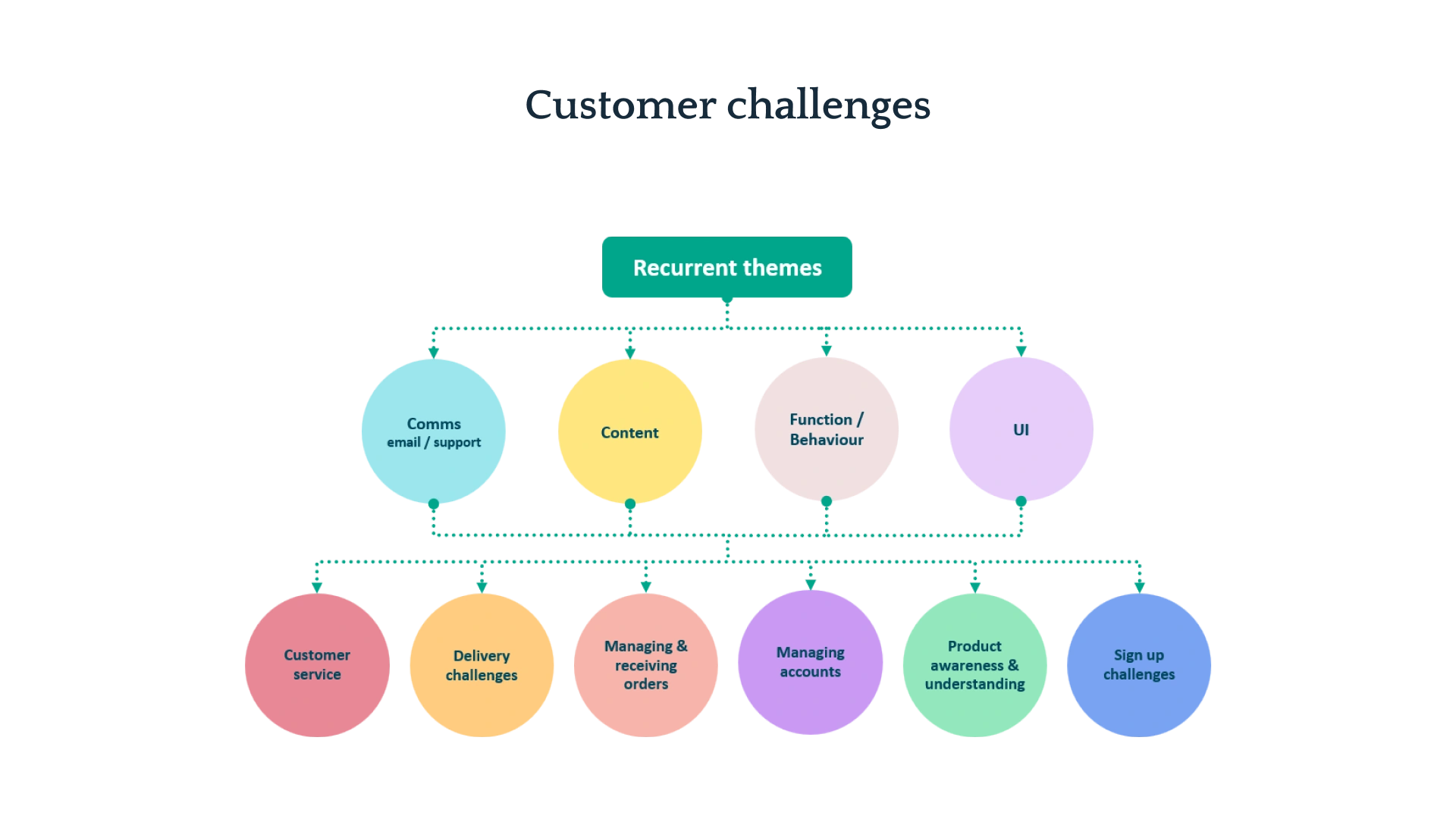
Recurrent challenges among prescription app customers.
My thinking

Mixed-method audit to reveal challenges across flows

The flagged decline in orders didn’t have a single, clear reason. Since patients were still signing up for the app, it was important to employ a range of auditing methods to identify the changes in conversion. 

‍

I used SUPR-Q survey* data to conduct a thematic analysis. Six themes emerged, ranging from delivery challenges and order management to product understanding and sign-up friction. 

‍

A cohort of approximately 100 customers who had contacted customer services in the previous 90 days was selected using purposive sampling. They were all existing Well customers who had signed up within that period. Their Intercom conversations* were assessed to identify the issues that had driven them to contact support and how those mapped to the broader themes from the SUPR-Q analysis.

SUPR-Q challenges

28.2%

Delivery challenges

‍

27.6%

Managing and receiving orders

‍

14.7%

Customer service communication

48-hour response times presented as live chat; chatbot limitations; in-store experience bleeding into digital perception

‍

12.2%

Product awareness for nominations

‍

12.2%

Sign-up challenges

‍

5.1%

Account management

‍

The most commonly cited issues, delivery and orders, were logistics challenges that were triaged but ultimately were the responsibilities of other stakeholders who sat outside of this project.

‍

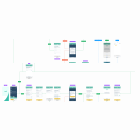
The entire Digital Pharmacy user journey was reviewed across both the mobile app (iOS and Android) and web platforms. Each screen and interaction was mapped, and observations were logged against specific Figma components. It covered content, UI, communications and functional behaviour. This produced a detailed annotated record of every issue identified, categorised by type and severity.

‍

*Survey responses and conversations were anonymised and only referred to by unique ID numbers.
‍

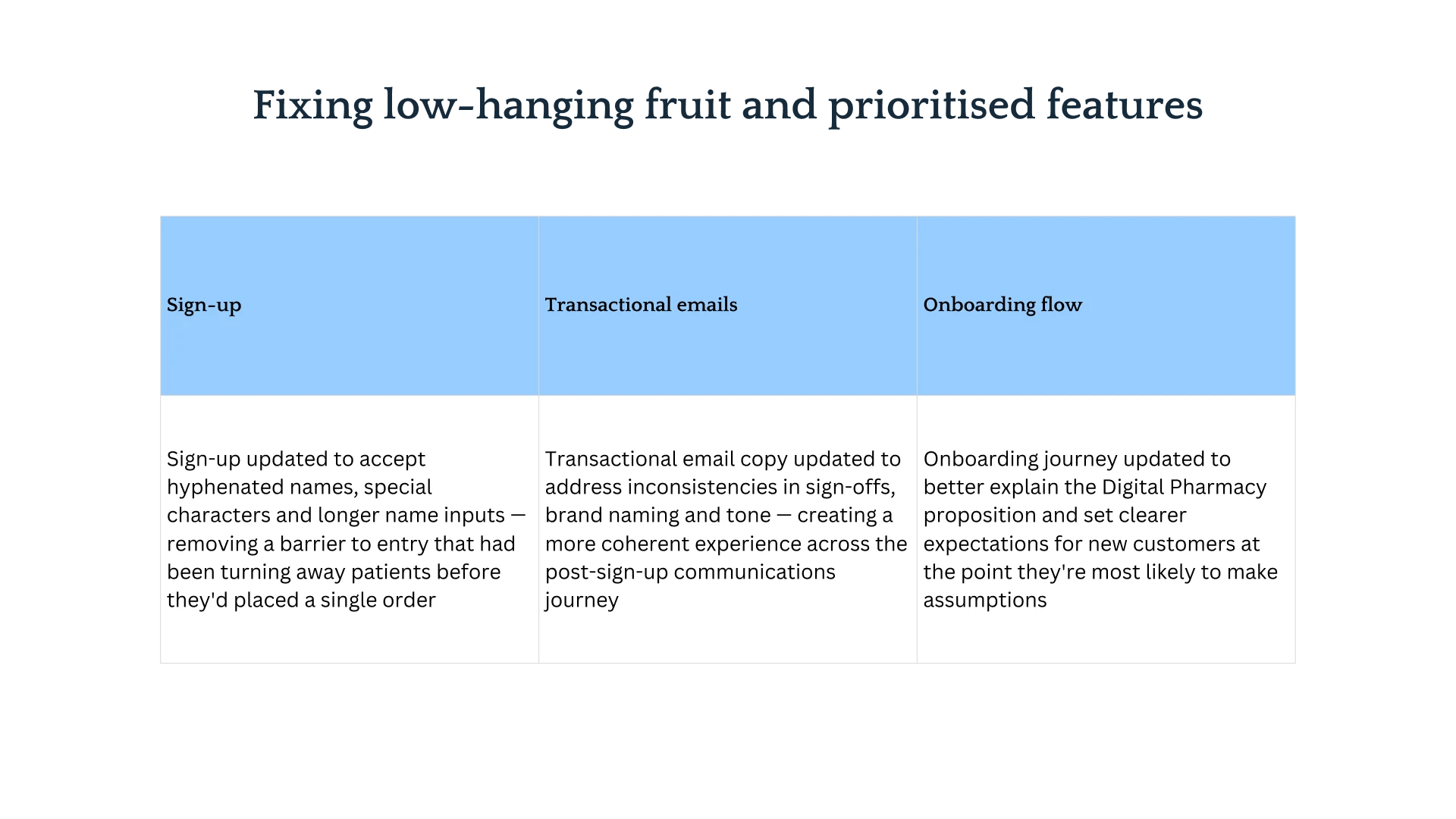
Approach to fixing sign-up, onboarding and email challenges.
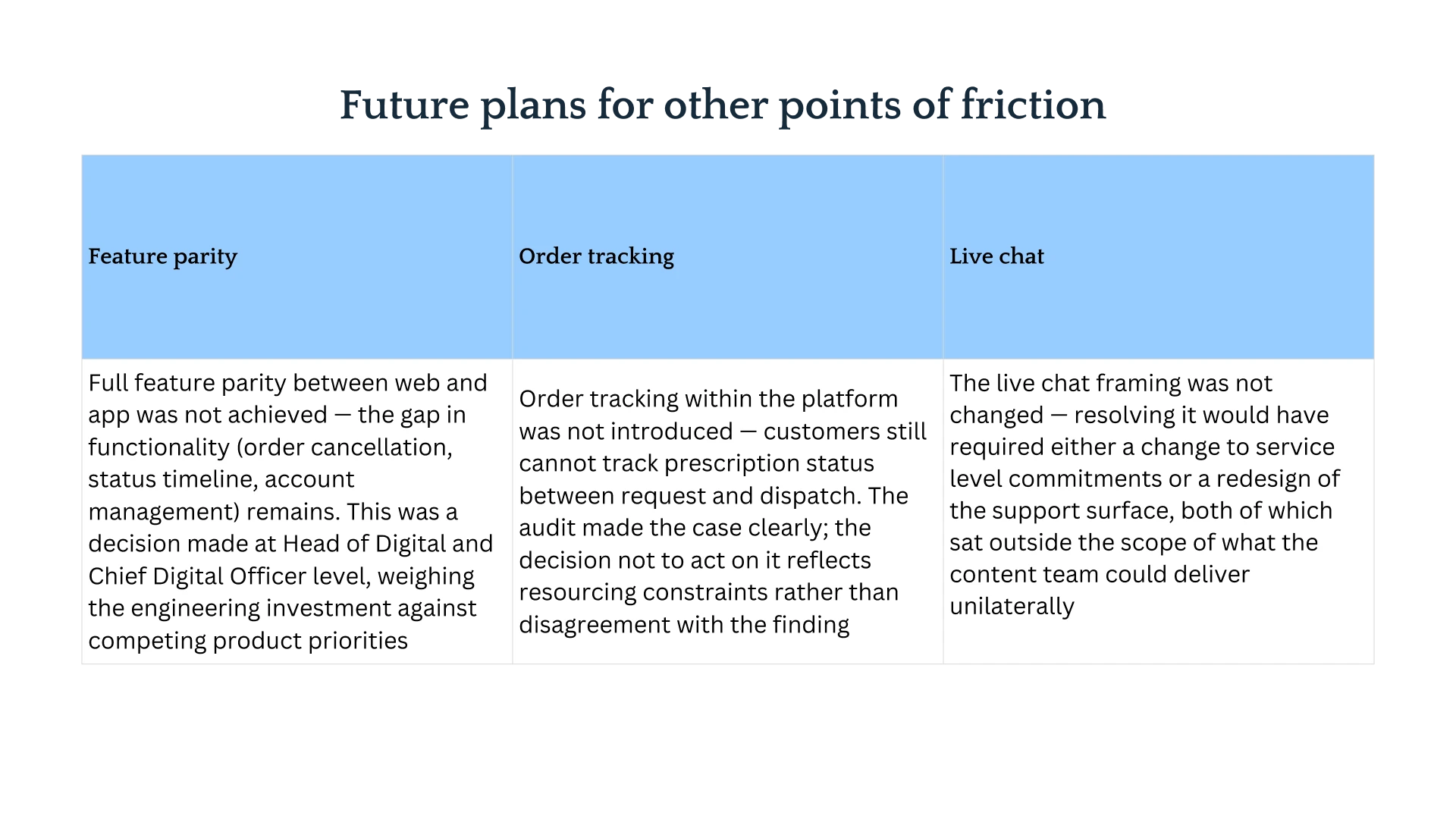
Plans for addressing other customer challenges.
My approach

Prioritising quick but effective fixes and creating a roadmap for the rest

Across all six themes, the flow testing and Intercom analysis consistently showed the same pattern: customers weren't failing because the service was broken. They faced challenges because they failed to understand what the service was, what it would do, or what they were expected to do next. 

‍

This meant that content changes were necessary. I worked on:

‍

  1. Clarifying nominations copy: Some patients didn’t know that they had changed the pharmacy where their prescriptions would be handled. In the instances where this occurred, they had typically ordered a one-off prescription item with well.
  2. Collaborating with the product designer on name input challenges: Special characters in names like hyphens were rejected at sign-up. This was a barrier to entry for a significant proportion of patients, and one that was particularly problematic because names on the platform need to match NHS records.
  3. Fixing password input challenges: Separately, the password field required a special character, but the error message didn't specify which characters were valid. Patients who encountered this problem had no path forward other than contacting customer services. Unsurprisingly, this meant that some dropped off.
  4. Improving content on customer service response times: The Intercom-provided customer service chat was labelled and positioned as a live chat service. But in practice, response times could be up to 48 hours within SLA and had occasionally exceeded that. It was creating trust and confidence problems for customers and patients. The content needed obvious improvement, but it had to be done in consultation with the customer service team, who were under significant time constraints.

‍

Beyond the content issues, the audit raised product-level and customer service issues. It was therefore important for me to work cross-functionally with the relevant stakeholders to decide on what would be implemented and what would be assessed and deprioritised with a view to action at a later date.

The fixes that were implemented gave all customers the ability to sign up, reducing drop-off during the early onboarding stages of the journey.

Learnings and reflections

Understanding user pain points relies on data from multiple sources

Within the comlex framework of a healthcare environment using analytics nd user-proided feedback and comments helps to paint the cleares picture of underlying problems

Content failures compound from the first moment of contact

The app store description problem, the hyphen rejection and the nomination consent ambiguity were all pre-service failures — they were damaging customer relationships before a single prescription had been ordered. Content that sets wrong expectations doesn't get a chance to recover from them. The audit reinforced how far upstream content decisions need to be evaluated.

Connecting content issues to commercial outcomes gives them weight

Framing the hyphen issue as "some names are rejected" would have generated a low-priority ticket. Framing it as "patients whose names include hyphens cannot sign up, and names need to match NHS records" made it a compliance and access issue. Framing the app store copy problem in terms of expectation mismatch and its relationship to conversion drop gave it urgency. Research findings move faster when they're anchored to consequences.

Mixed methods reveals what single methods miss

The SUPR-Q analysis showed that 28.2% of responses were about delivery. The Intercom analysis showed that tracking queries were the most frequent CS contact. The flow testing showed that order status language never updated during internal processing. No single method would have connected those three dots. The audit's value came from the triangulation — each source confirming and extending what the others had shown.

Some problems require a decision, not a fix

The feature parity gap and the live chat framing were real problems — clearly evidenced and well-understood by the teams involved. But resolving them required decisions that sat above the content and product team level. Part of the audit's job was to surface those issues clearly enough that the right people had the information they needed to make an informed call, even if that call was to defer. That's still a useful outcome.

More case studies