Governance and systems
Proving the commercial benefits of a content strategy
I built a framework that turned a legacy content library into a measurable commercial driver.

Governance
Content strategy
Commercial impact
Governance for digital pharmacy
I built a framework that turned a legacy content library into a measurable commercial driver.
Well Pharmacy is a leading pharmacy retailer, which offers prescriptions and health services to customers across the UK in both an online and in-store capacity.
In 2022, in a bid to engage its existing customers and leads more effectively, I worked on transforming its existing health content infrastructure into a commercially relevant ecosystem with a coherent strategy to steer it.
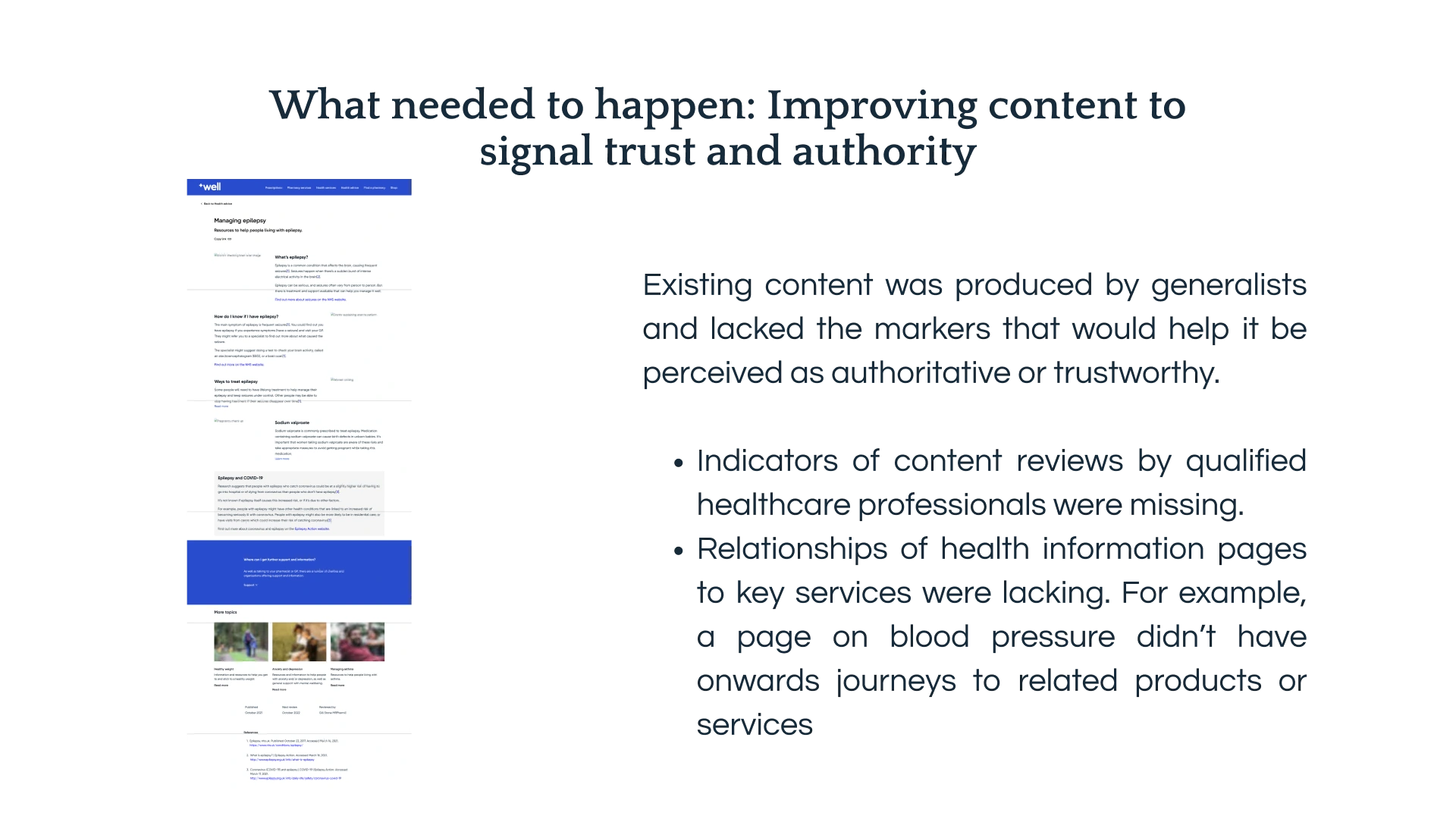
The company had an existing content library (Health Hub), which covered a range of health conditions common among its customer base. However, the main challenge was that this content was difficult to find and didn’t clearly explain or highlight how it related to the pharmacy’s already diverse offering of products and services.
There were several other issues that needed to be addressed:
Therefore, the goals for improving this content were clear. It needed to be made findable and become better integrated into key purchase journeys to support users with health conditions.
Simply put, it needed to be more than a nice-to-have. It had to demonstrate that its informational focus had value for customers beyond education.
After updating and improving the Health Hub content, I was able to evidence how it positively influenced purchase journeys for information-motivated customers. They were more confident in their weight-management-related purchases than those who didn’t engage with this content and found more content organically than they had previously.
Given the breadth and scope of content in Well Pharmacy’s digital estate, some senior stakeholders were concerned that a focus on the health content library would be a misuse of time. The website and app included commercial and transactional content that they thought it would be better to prioritise.
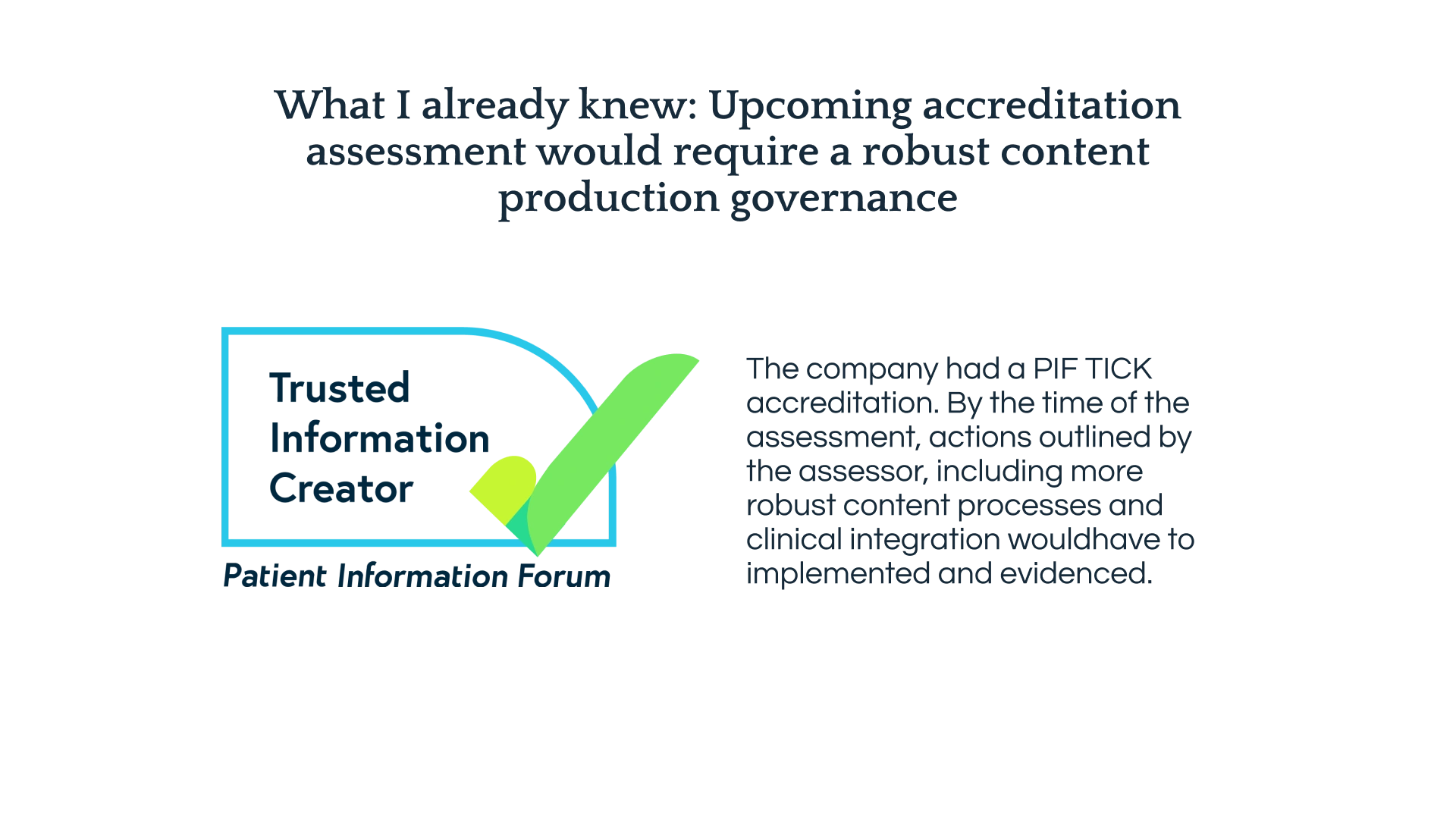
Although the project had kicked off and an audit of the Health Hub had started, they made the decision to remove their PIF Tick certification. This meant that the preparatory work for what was the upcoming assessment was deprioritised.
However, given this change happened after the project had already started, I continued to use PIF’s feedback about trust and authority while reviewing the structure and quality of the content.
With the stakeholder concerns in mind, I recommended that the relationship between health content pages and purchase journeys be investigated. Since the majority of Well Pharmacy customers were people with health conditions, my assumption was that this type of content could act as a form of support for them. But I needed to see this in action.
I planned to use data from Amplitude, Google Analytics and SEMRush to paint a picture of the role of health content in user journeys. This would form the basis of the argument with the senior stakeholders for pursuing its transformation.
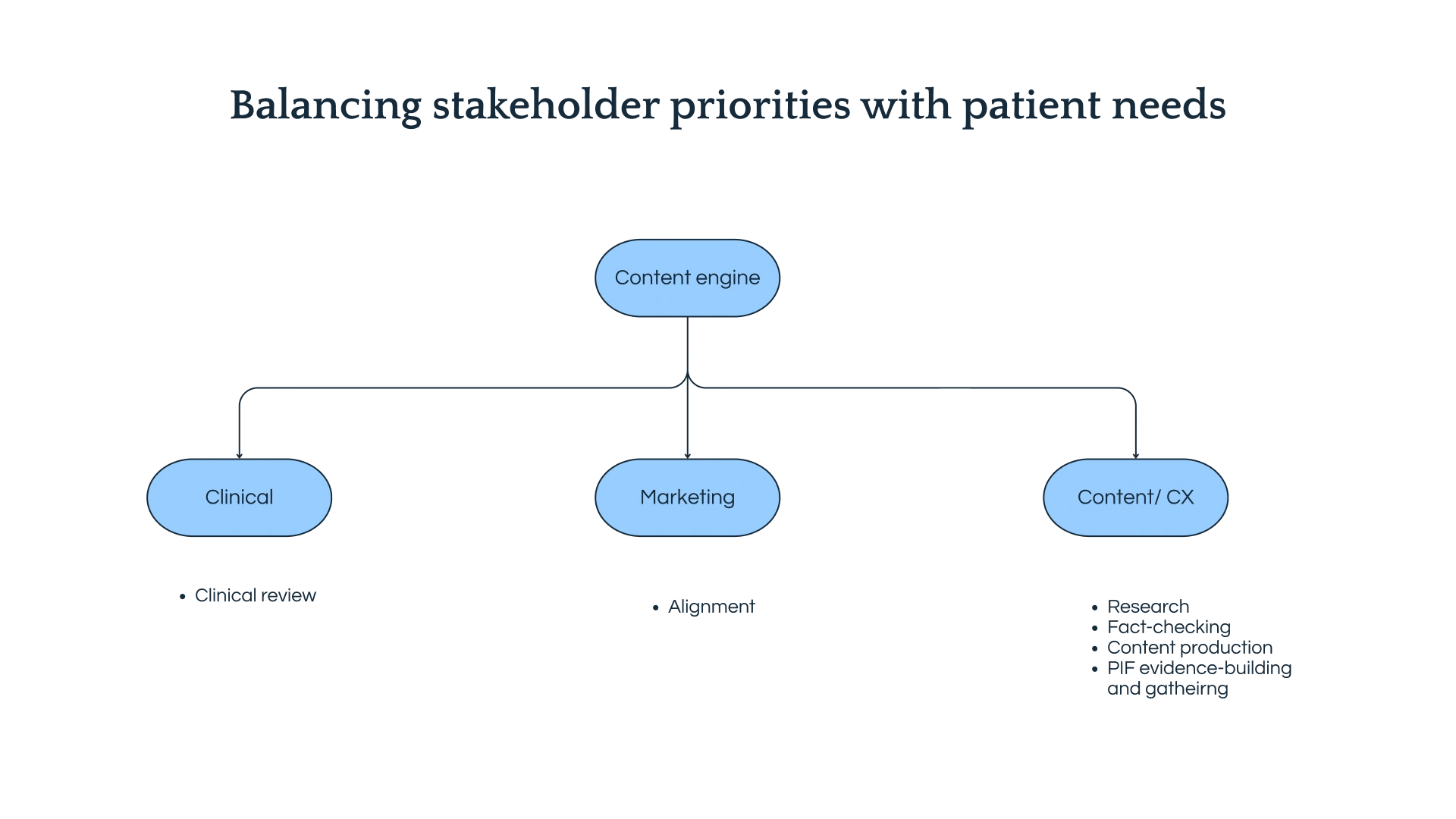
I would also need to create a governance framework to support the stakeholders involved in content production (CX, Product and Clinical) to be able to consistently produce accurate, relevant and authoritative content.
%201.webp)
I audited the existing content, assessing it for how well it met user needs and clinical requirements, as well as the gaps in quality, clarity and information.
Based on this work, I wrote three interconnected documents that formed the governance infrastructure. Each one served a dual purpose: meeting the clinical requirements we needed to satisfy and maintaining standards that would help in building trust and authority.
The Health Information Production Process
A fully documented workflow covering how content needs are identified, how evidence is gathered using an explicit hierarchy, how clinical reviewers are recruited and briefed, how lay users are involved in co-production, how accessibility is ensured, and how content moves through peer review, sign-off, and publication. Critically, I extended the process into the CMS itself: a peer review step was added at the page build stage, meaning that well-written content could not reach publication with formatting errors, broken links, or accessibility failures left unchecked.
The Editorial Style Guide
Defining tone of voice (warm, authoritative, clear, sensitive), punctuation and style conventions, inclusive language principles, trusted source hierarchies, and image guidelines. The guiding principles of simplicity, reliability, neutrality and sensitivity were chosen specifically because they reflect how patients need to receive health information, not how a marketing team would instinctively produce it.
The Content Purpose Framework
A strategic document articulating the purpose of each content type: what it is for, who it serves, where it sits in the patient journey, and how it connects to commercial outcomes. This was the document that made the internal commercial argument legible. It showed that informational content about conditions (heart health, menopause, sexual health, weight) was not separate from the prescription services that generated revenue but a pathway into them.
The result: What three years of governed content production looks like in data
The traffic trajectory since the introduction of the governance framework was the clearest signal of what systematic content investment produces. These figures are drawn from Semrush Traffic Analytics across three periods: the year before the team joined, the first year of the framework, and the sustained period that followed.
Before: Jan to Oct 2022
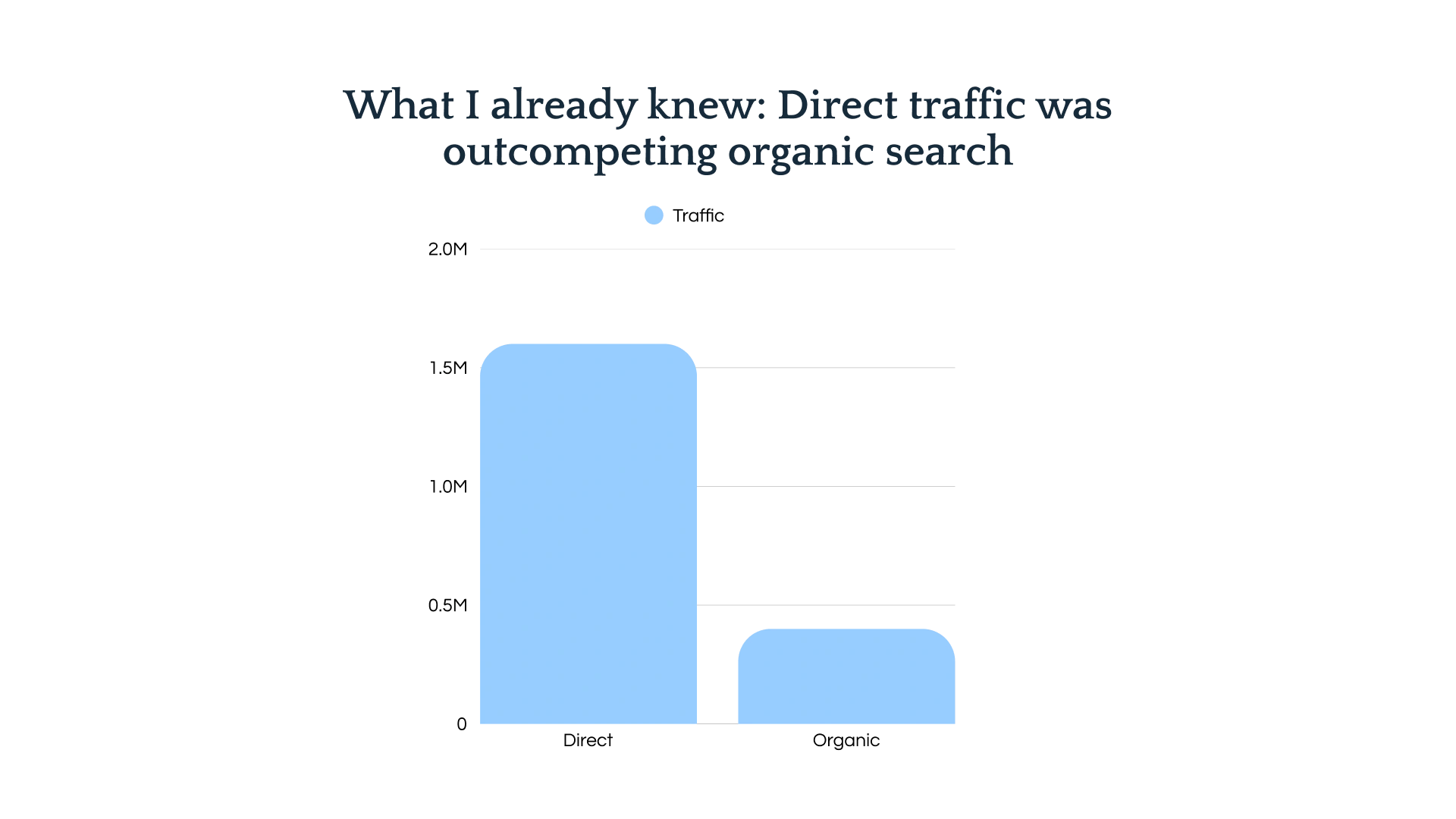
1.6 million total visits — predominantly direct traffic from existing patients
934,000 unique visitors
57.68% bounce rate
After: Nov 2023 to Oct 2025
5.3 million total visits — more than 3 times the pre-framework baseline
3.6 million unique visitors (a 13.24% increase year on year)
55.47% bounce rate — improved despite a much larger, more diverse audience
Traffic sources: Organic search is now a substantial, no-cost channel
The transition year (November 2022–November 2023) tells an important part of the story. Visits grew to 2 million as organic search began to scale.
By March 2026, the organic footprint told a more complete story with 97,000 keywords indexed in the UK, 168 million search impressions and 1.3 million clicks since November 2022. Non-branded organic traffic grew at over 27%. These were users who weren't looking for Well Pharmacy but who found it because the content answered a health question they had.
However, the traffic numbers were necessary but not sufficient to win the internal argument. What moved stakeholders was seeing the data expressed as a customer journey with a commercial outcome at the end of it. I built this case using Amplitude, tracking the behaviour of cohorts who had engaged with Health Hub content against those who hadn't.
The findings were consistent with the idea that the Health Hub had revenue-driving potential. Some key figures included:
Beyond this, my approach had benefits beyond what was expected. The governance framework I develop focused on credibility and clinical authority, which are attributes that AI search leans into when citing information for users with health-related queries. By March 2026, Well held an AI Visibility Score of 58, with 2,400 mentions and 1,500 cited pages across AI platforms. Google AI Overview alone referenced Well’s content over 1,400 times.
Connecting content to a business’ commercial goals involves listening to patient needs and developing content and journeys that respect them
In organisations where content is seen as a cost, the quality argument doesn't land first. The data that moved stakeholders wasn't about clinical credibility; it was about margin per prescription. Building that evidence layer in parallel with building the content was the thing that created space for the governance work to happen.
When leadership dropped the PIF TICK accreditation, I kept the practices. Not out of stubbornness, but because the work was in flight and would help in showing how standardised practices could influence content metrics. A framework that can be justified commercially is harder to dismantle and dismiss than one that can only be justified editorially.
Health Hub viewers converted at a higher rate than those who didn’t engage with the content. Designing content around genuine patient needs isn't a value position; it produces the highest-performing, highest-value acquisition cohort available to a pharmacy or digital health brand.
I didn't design the governance framework for AI search. But the referenced sources, clinical authorship, and evidence hierarchies that made the content trustworthy for patients turned out to be exactly what AI models look for when deciding what to cite. Building for one prepared us for the other.
Let's talk about your patients, products and your approach to improving health outcomes
.webp)